
Union County seat since 1843
Barndominium Builders in Monroe, NC
A planned county seat on US 74, surrounded by the farm country that still makes up much of eastern Union County.
- Free site visit before any price
- Written, line-item estimates
- County permit and septic research included
Barndominiums in and Around the County Seat
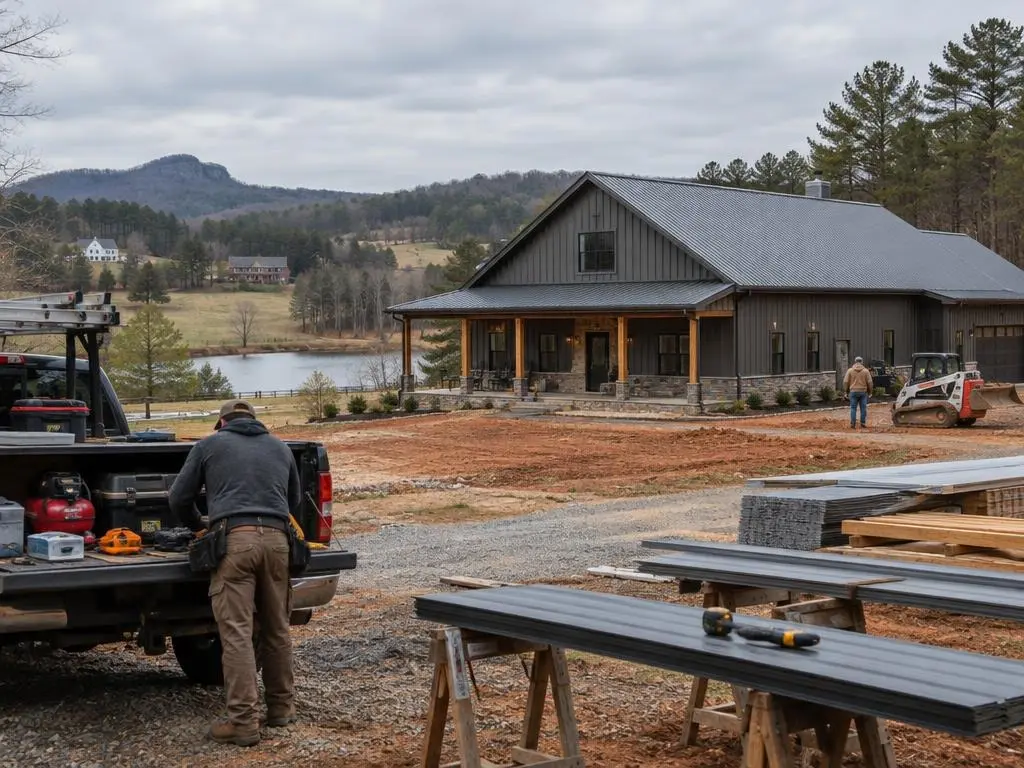
Barndominium builders who work in Monroe are building next to the offices that run land development for all of Union County. Monroe was laid out as a planned settlement in 1843, when the first county commissioners chose it as the seat of the new county, and it was named for President James Monroe. It grew as a trading center for the tobacco-farming Piedmont around it. Today the city has 34,562 residents (2020 census), a 2025 estimate of 42,644, and about 34 square miles of area at roughly 590 feet of elevation.
Getting around the land market
US 74 runs east-west through Monroe and US 601 runs north-south, while the Monroe Expressway bypasses the city. Charlotte-Monroe Executive Airport is about 5 miles northwest. Those corridors shape where barndo buyers look: parcels along the 601 and 74 lines toward Marshville, Wingate and Unionville still include working farmland and wooded tracts, while land closer to the expressway is in demand for new subdivisions.
Union County itself was formed in 1842 from parts of Anson and Mecklenburg counties and covers about 640 square miles. Its population reached 238,267 in 2020 and is estimated at 267,674 for 2025. The northern part of the county reaches into the southern foothills of the Uwharrie Mountains, so terrain gets a little rougher as you head toward the Stanly County line.
Septic first, house plan second
If your land is outside city water and sewer, the septic permit decides more about your barndominium than the floor plan does. Union County Environmental Health is at 500 N. Main St. in Monroe. A county notice effective March 17, 2020 required the applicant to supply a backhoe with a trained operator, with a bucket at least 2 feet wide, for site evaluations, or to submit a North Carolina soil scientist's soil and site report under Session Law 2018-114. The same notice capped each Improvement Permit application at 3.0 acres of evaluation, and a March 18, 2020 notice temporarily suspended new septic and well applications at the time. Those notices are from 2020, so we confirm the county's current procedures before you commit to a parcel.
The state's On-Site Water Protection Branch oversees the program with local health departments, and also handles inspection and testing of private wells built, repaired or abandoned on or after July 1, 2008.
Reading the ground
Piedmont soils around Monroe often have clay subsoils. Two USDA series show the range a builder plans for:
- Pacolet: well drained, moderate permeability, red clay subsoil, found on gently sloping to very steep Piedmont uplands.
- Iredell: moderately well drained, very slow permeability, with very high shrink-swell potential in the clay subsoil.
A site that leans toward the second type needs more attention to slab design, gutters and grading, and may limit where a drain field can go.
Historic city, new construction
Monroe has three National Register historic districts: the Downtown, Residential and Waxhaw-Weddington Roads districts. A metal-sided barndominium is a poor match for those blocks, and most barndo projects tied to Monroe end up on the rural edge of the city or in the unincorporated county. Before design starts, we check the parcel's zoning and whether city or county rules apply.
How a Monroe-area build runs
1. Confirm jurisdiction, zoning and any deed restrictions. 2. Soil evaluation and septic Improvement Permit (or confirm water and sewer availability). 3. Floor plan, structural design and building permit under the 2024 North Carolina State Building Code, effective July 1, 2025. 4. Clearing, driveway and culvert, pad and slab. 5. Steel or post-frame shell, roof and dry-in. 6. Insulation, HVAC, trades, and interior finish-out.
Monroe is a practical place for a shop house: a big door bay for equipment, a mudroom between shop and kitchen, and living space upstairs or alongside. Call (980) 689-3758 or
to start with your land.Monroe Building Notes
- County seat. Monroe was founded in 1843 as the planned seat of Union County, which was formed in 1842 from Anson and Mecklenburg counties.
- Highways. US 74 and US 601 cross in Monroe, and the Monroe Expressway bypasses the city.
- Environmental Health office. Union County Environmental Health is at 500 N. Main St., Suite 47, in Monroe.
- Historic districts. Downtown, Residential and Waxhaw-Weddington Roads historic districts are listed on the National Register.
- Population. 34,562 in 2020, with a 2025 estimate of 42,644.
Monroe Questions
Where do I go for a septic permit near Monroe?
Union County Environmental Health at 500 N. Main St. in Monroe. A March 2020 county notice called for a backhoe and operator at the site evaluation, or a soil scientist's report; ask the county what applies today.
Can I put a barndominium in one of Monroe's historic districts?
Historic districts carry design expectations that rarely suit a metal-sided home. Rural parcels outside those districts are a better fit; we check the rules before design.
How much land can one septic evaluation cover?
A Union County notice from March 2020 capped each Improvement Permit application at 3.0 acres of evaluation. We confirm whether that limit still applies before the evaluation is scheduled.
Do private wells get inspected?
Yes. North Carolina's program covers inspection and testing of private wells built, repaired or abandoned on or after July 1, 2008.
Free Estimates in Monroe, NC
Free estimates for barndominium homes and shop houses around Monroe.
Barndominium Builders Near Monroe
- Barndominium Builders in Charlotte, NC
- Barndominium Builders in Concord, NC
- Barndominium Builders in Harrisburg, NC
- Barndominium Builders in Kannapolis, NC
- Barndominium Builders in Mooresville, NC
- Barndominium Builders in Statesville, NC
- Barndominium Builders in Huntersville, NC
- Barndominium Builders in Mint Hill, NC
- Barndominium Builders in Matthews, NC
- Barndominium Builders in Indian Trail, NC
- Barndominium Builders in Waxhaw, NC
- Barndominium Builders in Marshville, NC
- Barndominium Builders in Locust, NC
- Barndominium Builders in Albemarle, NC
- Barndominium Builders in Salisbury, NC
- Barndominium Builders in China Grove, NC
- Barndominium Builders in Gastonia, NC
- Barndominium Builders in Belmont, NC
- Barndominium Builders in Mount Holly, NC
- Barndominium Builders in Cherryville, NC
- Barndominium Builders in Lincolnton, NC
- Barndominium Builders in Shelby, NC
- Barndominium Builders in Midland, NC
- Barndominium Builders in Stanfield, NC